 KnowSoda
Politics test
Political ideology test: what’s yours?
Answer statements and political dilemmas about the economy, society and power. Explore the ideology closest to your views and the figures who share them.
- 20 axes in 6 branches
- 10 dilemmas
- Country survey data with sources and dates
Free · Anonymous · No sign-up
Example results
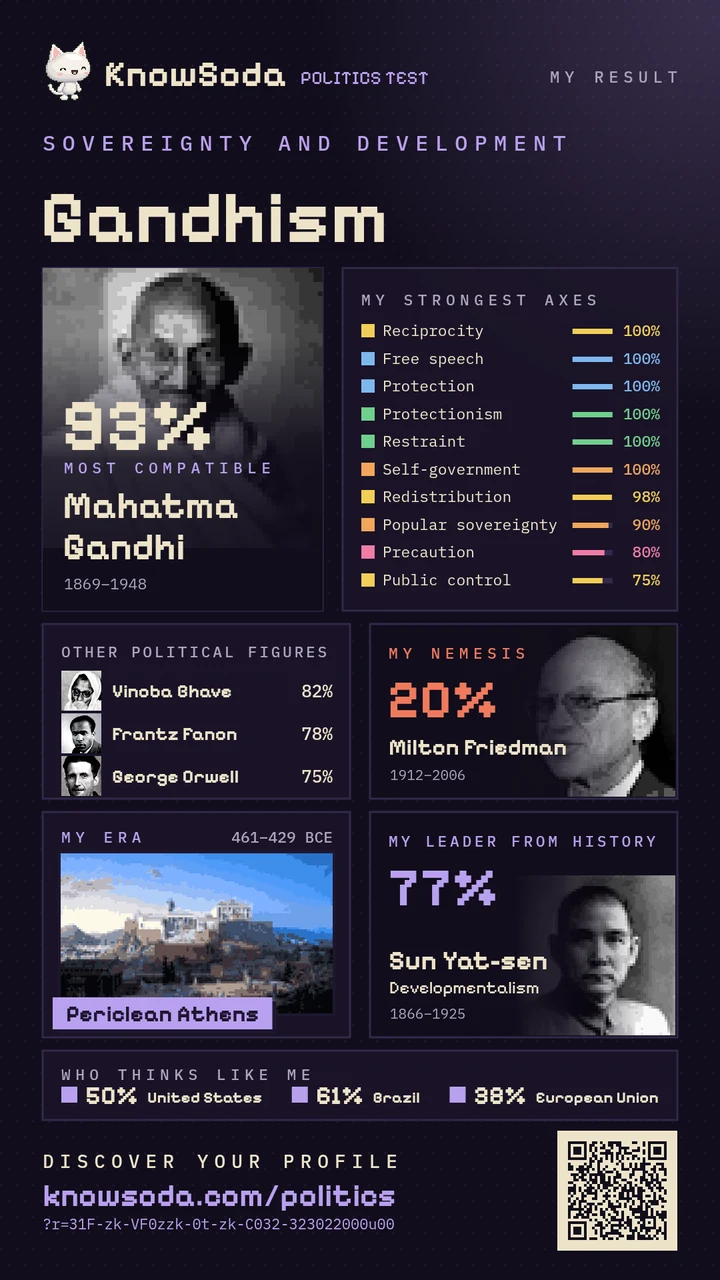
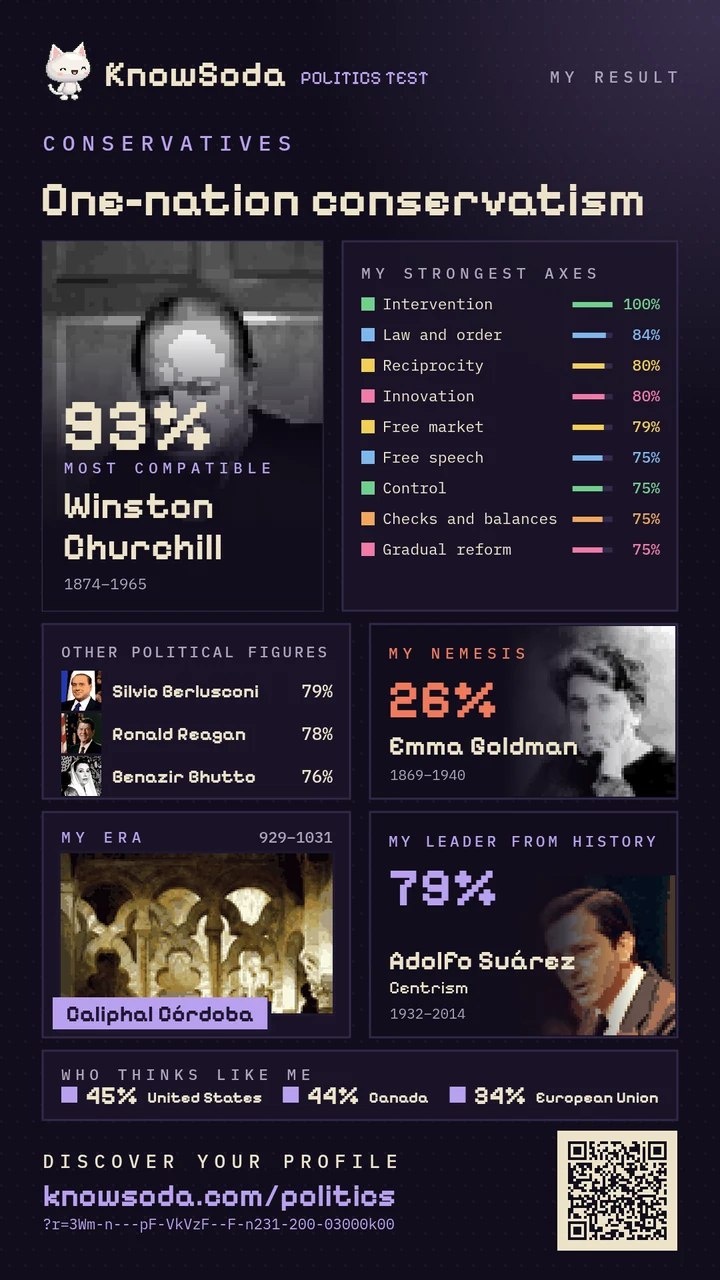
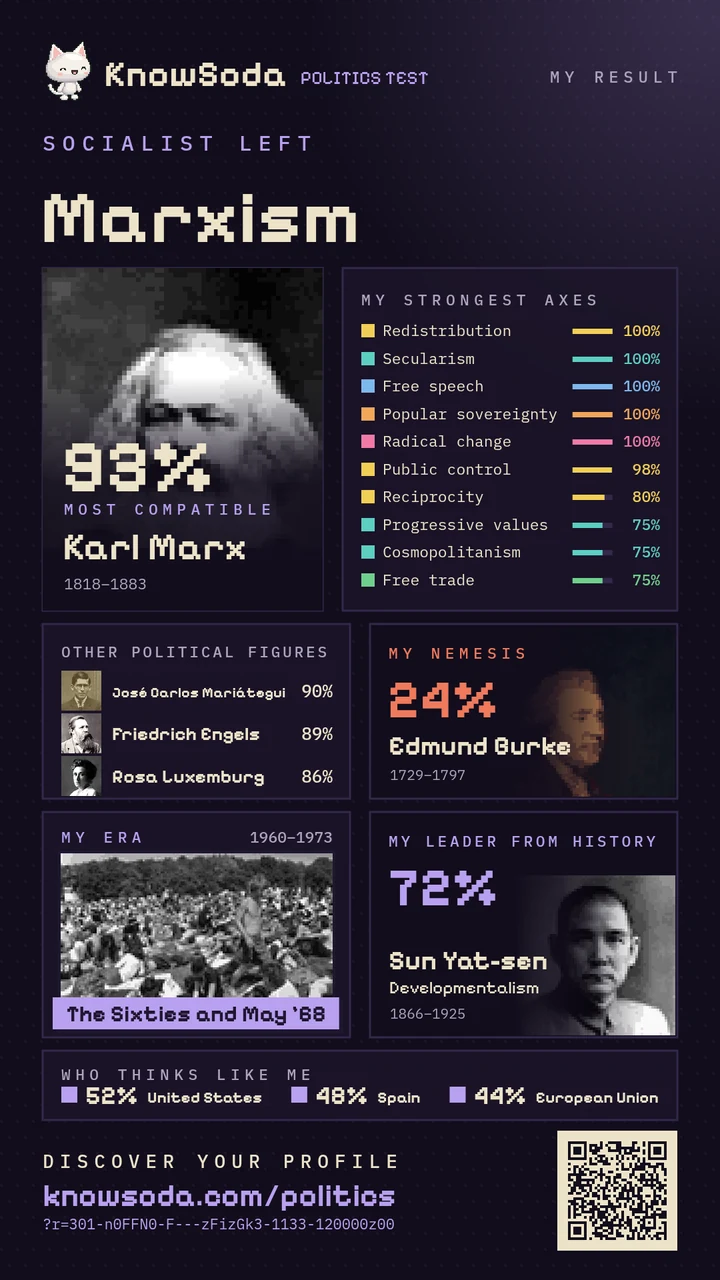

How it works
Your answers place you on 20 axes. We compare your profile with documented political views and with ideologies, using both their definitions and the figures associated with them.
Country comparisons use published survey questions. Each question keeps its wording, year and source; coverage varies by country.
This is a way to explore ideas. Similarity on these axes does not mean agreement with everything a figure said or did.
Sources. Positions: writings, documented policies and historical studies. Surveys: CIS, Pew Research Center, GSS, CES, INEGI and Eurobarometer. Inferred positions and historical analogies are editorial interpretations.
Who should steer the economy: free markets or the state?
Example only. Your answers place the marker.
Political ideology test: common questions
What is a political ideology test?
A political ideology test asks what you think about issues such as taxes, rights, immigration or the role of the state, then shows which set of political ideas sits closest to your answers. It doesn’t diagnose you or predict how you vote. It’s a way to see your own views laid out and compare them with ideas you may not have a name for.
How does this politics test work?
You react to statements on a five-point scale, from “Strongly disagree” to “Strongly agree”, and face dilemmas where you pick one of four actions. It comes in three lengths. Your answers place you on 20 axes in six branches: economy, society, freedoms, the world, democracy and the future. You can also answer “I don’t know” or call a question badly posed.
How is this different from a left-right political spectrum quiz?
A simple political spectrum quiz puts you at one point on a line from left to right. This test measures 20 axes separately, so you can lean one way on taxes and another on immigration, trade or technology. Your result shows your profile branch by branch, the closest ideology and the documented figures nearest to you, instead of one score.
Does this test favor any side?
It tries not to, but no test is fully neutral. Each axis has statements pointing both ways, so agreeing with everything lands you near the middle of every axis, not on one side. It doesn’t tell you who to vote for. Still, we chose the axes, the wording and how to read each figure, and most figures come from Europe and North America.
Who are the documented figures in the test?
They are thinkers, politicians and rulers, from antiquity to today, living and dead. They take no part in KnowSoda and do not endorse it. Their positions are our own reading of public sources such as writings, documented policies and historical studies, and some are inferred. Being close to a figure on these axes doesn’t mean agreeing with everything that person said or did.
What happens to my answers?
Your answers and results stay in your browser, or on your phone in the app, and we don’t receive them. You don’t need an account, and the website sets no cookies and uses no analytics. Your answers can reveal what you think, so you decide who sees them: anything you share shows your result, and a result link carries it, so our web host receives it when the link is opened.


