 KnowSoda
Maths test
Which mathematician are you?
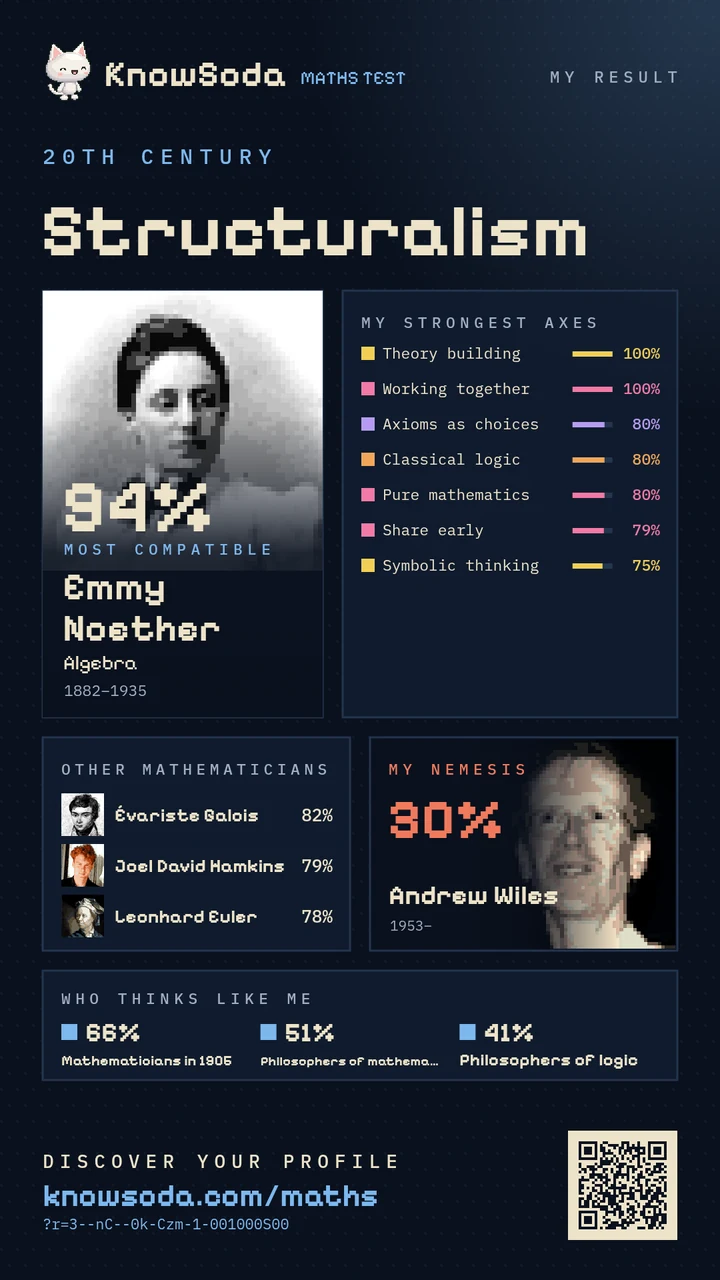
Twelve axes, from whether numbers are discovered or invented to whether you’d rather work alone. Answer, and find out which mathematicians and logicians think like you, who your nemesis is, and how you compare with philosophers and mathematicians.
- 12 axes in 4 branches
- 6 dilemmas
- Data from PhilPapers 2020 and two surveys of mathematicians
Free · Anonymous · No sign-up
Example results



How it works
Each axis is a real question about mathematics or how it is done, with a position at each end. Your answers place you on every one, and your profile is compared with each mathematician’s documented views: their own writings, the Stanford Encyclopedia of Philosophy, MacTutor and biographies.
Where a question matches one from a real survey, you also see how many stand where you do: philosophy professors (2020) and mathematicians (2019 and 1905).
It’s a way to explore ideas, not a scientific instrument: a high match means your answers are close to a mathematician’s documented views, not that you share all of them.
Sources. Mathematicians’ positions: their own writings, the Stanford Encyclopedia of Philosophy, MacTutor and biographies. Surveys: the 2020 PhilPapers Survey (Bourget and Chalmers), Weber and Czocher (2019) and L’Enseignement Mathématique (Fehr, 1908).
Is mathematics discovered or invented?
Example only. Your answers place the marker.